HOME | PRACTITIONERS
The professionals who run
the diagnostic, issue the record,
and hold the line.
HSRL-certified practitioners are the human infrastructure that makes the diagnostic defensible. They run the assessment, verify the evidence, issue the GCR, and maintain the professional boundary that gives the certification its meaning. The credential is real. The standard is not negotiable.
THE PRACTITIONER ROLE
Three things. Not four.
The boundary is the credential.
The HSRL practitioner role is precisely defined because the boundary of the role is what makes the certification credible. A practitioner who builds what they certify is not an independent auditor — they are a contractor self-certifying their own work. HSRL certification means something specific: an independent trained assessor applied a validated methodology and documented what they found.
Practitioners bring their existing domain expertise — forensic accounting, safety engineering, civil rights advocacy, legal practice, procurement consulting, public health — and apply the HSRL five-condition framework to systems in their domain. The methodology travels across domains. The domain expertise of the practitioner determines what they are most effective at assessing.
The practitioner does not prescribe solutions. They define what each condition structurally requires, assess whether the organization has met it, and document the finding. How the organization meets the standard is the organization's decision to make and own. This is not a procedural nicety — it is the reason governance structures built through HSRL certification survive organizational change.
Function 01
Define
The practitioner defines what each of the five conditions structurally requires to be scored present, partial, or absent. They communicate this to the client through the Remediation Pathway Document — not through drafting the documents for them. The standard is HSRL's. The practitioner applies it.
Function 02
Verify
The practitioner returns under a separate re-audit engagement and verifies whether the evidence presented meets the HSRL verification criteria. Conditions that don't meet the standard receive a specific written finding. The organization revises and resubmits. The practitioner does not revise on the organization's behalf.
Function 03
Certify
When all five conditions are verified, the practitioner issues the GCR — a SHA-256 signed record documenting the governance state at the time of certification. The record is logged to the SGL. It cannot be amended — only superseded by a new GCR with a dated amendment record. The certification is credible because the practitioner did not build what they certified.
WHO THIS IS FOR
Professionals who already do some version of this work
without the framework or the record.
HSRL certification adds methodology, validation, and a defensible record to domain expertise you already have. It is not a career change. It is infrastructure for the kind of work you're already doing.
⚖️
Forensic & Legal Professionals
You already assess what governance structures existed at the time of harm. HSRL gives you a validated methodology for doing that assessment pre-harm, and a forensically defensible record that documents what was present and what was absent before deployment.
Forensic accountants and auditors
Legal practitioners in tech liability, civil rights, and regulatory compliance
Expert witnesses in technology and governance cases
Compliance officers with litigation support backgrounds
Internal auditors and risk management professionals
📣
Advocates & Policy Professionals
You already document what governance failures look like after harm occurs. HSRL certification gives you a methodology for documenting those same structural gaps before deployment — producing evidence that is useful to affected communities, oversight bodies, and legislative processes without requiring legal proceedings to generate it.
Civil rights and digital rights advocates
Benefits and welfare system advocates
Technology policy researchers and analysts
Journalists covering accountability in automated systems
Community organizers working on technology governance
🏗️
Procurement & Governance Consultants
You already advise public agencies on technology procurement. HSRL certification gives you a validated pre-deployment assessment product you can deliver as part of every engagement — with a SHA-256 signed record your clients can use in contract documentation, OIG submissions, and public oversight responses.
Public safety and law enforcement technology consultants
Government technology procurement advisors
ERP and automated system implementation consultants
AI governance and ethics consultants
Public health informatics professionals
🏛️
Public Sector Professionals
You work inside the agencies that deploy automated systems. HSRL certification gives you the methodological infrastructure to conduct structured governance assessments on systems your agency uses — and, for agencies with the Agency SGL, a live ledger that tracks governance conditions across every system you're responsible for.
Inspector general staff and legislative auditors
IT governance and compliance officers
Procurement officers in local and state government
Oversight board members and staff
Government accountability office researchers
🔬
Safety Engineers & Systems Analysts
You already work in systems where structured pre-deployment assessment is standard practice. HSRL gives you a governance framework that runs parallel to the technical safety assessment — and a certification architecture that produces a pre-harm record at the organizational level, not just the technical level.
Aviation, nuclear, and healthcare safety engineers
Human factors engineers and human systems integrators
Risk management professionals with systems backgrounds
Accident investigators and post-incident analysts
Researchers in sociotechnical systems and organizational failure
🎓
Researchers & Academics
You already study the governance conditions that separate harmful from resilient automated systems. HSRL certification gives you access to the 380-case validated dataset, a methodology that has demonstrated empirical accuracy, and a pathway to translate research findings into operational assessments that produce pre-harm records.
Human factors and sociotechnical systems researchers
AI ethics and algorithmic accountability scholars
Organizational failure and accident investigation researchers
Public administration and governance researchers
Law and technology scholars
Not the right fit
HSRL certification is not appropriate for vendor employees, vendor-affiliated consultants, or anyone whose income depends on a specific system's continued operation. The independence requirement applies to the practitioner relationship as well — a practitioner cannot certify systems sold by a vendor they have a commercial relationship with. This is not an ethical preference. It is what makes the certification mean something.
PROFESSIONAL STANDARDS
The standards that make
the credential worth something.
HSRL practitioner certification carries binding professional obligations. These are not aspirational guidelines. They are conditions of maintaining an active credential and an active directory listing. Practitioners who do not meet these standards have their credentials suspended or revoked.
Required — Active Credential
Errors & Omissions Insurance
All HSRL practitioners must carry active Errors & Omissions (E&O) insurance for the duration of their credential. A current certificate of insurance must be filed with HSRL and kept up to date. Your directory listing remains live only while HSRL holds a current, valid COI on file. If your coverage lapses or your COI expires without renewal, your listing is suspended until a current certificate is received.
Why this requirement exists: HSRL practitioners issue signed governance records that are used in procurement decisions, legal proceedings, and oversight submissions. E&O coverage protects both the practitioner and the clients who rely on those records. A practitioner practicing without it is not a practitioner in good standing.
Required — All Practitioners
Vendor Independence
No practitioner may conduct or issue a GCR for a system sold or operated by a vendor they have a current commercial relationship with. This includes employment, consulting agreements, revenue-sharing arrangements, or any financial relationship that creates a material interest in the vendor's continued operation. The prohibition applies regardless of whether the practitioner believes they can assess objectively.
Practitioners must disclose any prior vendor relationship — including relationships that ended within the past two years — before accepting an assessment engagement in that vendor's domain. HSRL retains the right to require reassignment to an independent practitioner based on that disclosure.
Required — All Practitioners
Findings Integrity
A practitioner may not alter, soften, withhold, or delay a finding based on client pressure, client relationship, or anticipated commercial consequence. If a condition is absent, the finding is ABSENT. The GCR reflects what the evidence supports — not what the client wants the record to say. Practitioners who report findings inaccurately, issue GCRs without adequate evidence review, or allow client pressure to influence scoring are subject to immediate credential suspension and referral for professional review.
Clients may dispute a finding through the formal HSRL amendment process. That process requires new evidence and a second practitioner review. It does not involve the original practitioner revising their finding under client pressure.
Required — Channel Partners
Channel Partner Diagnostic Separation
A channel partner who refers an organization to HSRL cannot conduct the diagnostic assessment for that organization. The referral relationship and the assessment relationship must be held by two different practitioners. This preserves the independence of the finding and protects both the referring partner and the assessed organization from conflicts of interest that would compromise the record's defensibility.
When a referred organization is ready for assessment and no independent certified practitioner is available, the HSRL founding director steps in as the practitioner of record until a qualified independent practitioner can be trained and assigned. The assessment does not proceed with a conflicted practitioner — it waits for an independent one.
The principle: The value of an HSRL GCR comes from the independence of the person who issued it. A channel partner has a financial interest in the relationship succeeding. That interest, however legitimate, cannot be present in the same person conducting the governance assessment.
Required — All Practitioners
No Building What You Certify
Practitioners define what each condition requires and assess whether the organization has met it. They do not draft the policies, write the documentation, or build the governance structures they will later verify. The assessment function and the implementation function must be separated. A practitioner who builds what they certify is not an auditor — they are a contractor self-certifying their own work.
This does not prohibit a practitioner from conducting a subsequent engagement after remediation — it prohibits them from conducting the remediation work itself on behalf of the same client within the same GCR cycle. Practitioners may provide general guidance on what a condition requires without providing the specific implementation deliverables.
Required — All Practitioners
Confidentiality and Conflict Disclosure
Practitioners must maintain client confidentiality consistent with the terms of each engagement. They may not use client-specific information obtained in an assessment engagement to benefit a competing client, a vendor relationship, or any third party. Case studies derived from client engagements require client consent before submission to the HSRL case database, with identifying information removed unless the client consents to named publication.
Practitioners must proactively disclose any potential conflict of interest — including prior employment, financial relationships, personal relationships, or prior adversarial involvement — before accepting an engagement. When in doubt, disclose. HSRL will advise on whether the relationship requires reassignment.
Credential Suspension or Revocation
The following result in immediate credential suspension pending professional review: lapsed E&O coverage without current COI on file · conducting a diagnostic for an organization you referred as a channel partner · issuing a GCR without completing the required evidence review · altering a finding under client pressure · undisclosed vendor or financial conflict of interest · building implementation deliverables for a client within the same GCR cycle you will assess · any material misrepresentation on a GCR or Remediation Pathway Document. Revocation is permanent and noted in the HSRL public credential registry
THE PRACTITIONER SGL
Free for every practitioner.
Your complete practice infrastructure
from day one.
The Practitioner SGL is free for all HSRL-certified practitioners. It is not a paid add-on and it is not gated behind a license tier. Every practitioner who holds an active HCGD credential gets full Practitioner SGL access as part of their certification — because the SGL is the infrastructure that makes your practice work, not a premium feature.
Every client engagement, every GCR issued, every condition score, every re-audit cycle — all logged in one place across your entire client roster. Your practitioner credential status, active certifications, and GCR issuance history are all visible here. Agencies that can't see your full ledger can see your practitioner credential and certification status — that is what they're evaluating when they consider engaging you.
How you work inside the SGL depends on whether your client has the Agency SGL embedded in their systems. Both modes are fully supported. The record you produce is equally defensible either way.
Mode A — Client Has the Agency SGL
You credential into their ledger and work inside it
The agency invites you in as a credentialed accessor for specific systems. You run diagnostics directly inside their Agency SGL — your findings, condition scores, and GCRs are logged in real time to their ledger with your practitioner ID and timestamp attached. Everything you do is also mirrored to your own Practitioner SGL. The agency owns the record. You issued it. Both sides have the full history.
Mode B — Client Does Not Have the Agency SGL
You hold the record. They receive signed documents.
Your Practitioner SGL holds the complete record history for this client. You run diagnostics from your own SGL, issue SHA-256 signed GCRs and Remediation Pathway Documents, and deliver them as formatted PDFs. The record exists in your ledger and is retrievable on request — for oversight bodies, legal proceedings, or procurement documentation. If the client moves to embedded HSRL later, the historical record migrates to their Agency SGL intact.
📋
Full Client Record History — Both Modes
Every GCR issued, every condition score, every re-audit cycle logged for every client — whether they have an Agency SGL or not. Your complete professional record in one place.
🔑
Agency SGL Credential Access
When an agency invites you into their Agency SGL, you run diagnostics directly inside their ledger. Every action is logged with your practitioner ID and mirrored to your own SGL.
📅
Re-Audit Schedule Tracking
The SGL tracks every GCR-002 annual review due date and flags approaching windows across your entire roster — Agency SGL clients and PDF-only clients alike. No manual tracking.
🔭
Coming Soon — Case Structural Governance Expansion
The Practitioner SGL is expanding to support case-level structural governance assessment — applying the five-condition framework to individual case records across additional domain verticals. Founding practitioners will have early access and direct input into what gets built.
📤
Signed Document Output
For clients without Agency SGLs, generate SHA-256 signed PDF GCRs, Remediation Pathway Documents, and amendment records directly from your SGL — formatted for procurement, OIG, and legal use.

HCGD CERTIFICATION
HSRL certification is a meaningful
professional credential.
Not a paid badge.
The Human-Centered Governance Diagnostic (HCGD) designation requires demonstrated competency, supervised practice, and active maintenance. You cannot pay your way to certification. You cannot bypass the practicum.
01
Foundations Training
The methodology, the five conditions, the case library structure, the diagnostic protocol, and the professional standards for findings presentation. Self-paced with live Q&A sessions.
Covers: GPWS scoring · 57 triggers · Hard-block trigger protocol · Case match methodology · SGL architecture · GCR record standards · Practitioner boundary doctrine · Professional independence requirements
03
Certification Assessment
Correct application of the five conditions, appropriate case matching, professional documentation standards, and defensible findings presentation. Structured assessment — not a quiz.
Assessed on: a live or training-case diagnostic with structured evaluator review of the full output — condition scoring, evidence citations, case match selection, Remediation Pathway Document quality, and GCR-ready documentation format
02
Diagnostic Practicum
Three supervised diagnostics on real or training systems with written feedback from a certified HSRL mentor. Where the methodology becomes fluent in practice, not just in theory.
Supervised by: certified HSRL mentor · Assessed on: trigger application accuracy, hard-block recognition, case match quality, Remediation Pathway Document drafting, findings presentation clarity, practitioner boundary maintenance under pressure
04
Active Maintenance
Annual renewal: continuing education hours, contribution of at least one case study or methodology observation to the community forum, active license in good standing.
Renewal requires: CE hours completed · Community contribution logged · License fee current · No active ethics findings · Annual acknowledgment of HSRL professional standards
What makes the credential
worth something
The HCGD designation means that an independent trained assessor applied a validated methodology to a specific system and documented what they found. Every person who holds the credential went through the same supervised practicum. Every GCR they issue is logged to the SGL and cannot be retroactively amended. The credential is only worth something if the standard for getting it is real — which means it is not easy to get, not renewable by payment alone, and revocable if the professional boundary is violated.
LICENSE TIERS
The Practitioner SGL is free.
What the license buys is
everything built around it.
Every HSRL-certified practitioner gets the Practitioner SGL free — no tier required. License tiers cover the platform features that support your practice at scale: case match engine depth, document output, white-label options, directory placement, and seats. Founding members get all of that plus education, certification, practice management support, and growth resources — free in year one.
● Founding Member
Founding
First cohort — co-builders of the institution
$0 year one · Rate locked from year two
Full Solo platform access · Education & certification free · Practice management & growth support included · Permanent founding designation
Practitioner SGL — free (as with all practitioners)
Full diagnostic platform and case match engine
Document output — GCRs, Remediation Pathway, amendment records
Education free — full foundations curriculum, all training modules, CE hours
Certification free — HCGD practicum, assessment, and credential issuance
Practice management support — supervised practicum, mentorship, structured feedback on your first engagements
Growth support — priority directory placement, direct HSRL access, input into platform and framework development
Permanent founding designation on every GCR you issue
Founding rate locked from year two regardless of future price increases
Firm
Firm
Consulting firms and multi-practitioner practices
$15,000–$35,000 / year
Up to 8 seats · White-label document output · Firm directory listing
Practitioner SGL — free for each credentialed seat
Up to 8 practitioner seats — all with individual HCGD credentials
White-label document output for client deliverables
Firm-level directory listing with practitioner roster
Priority case database access
Quarterly strategy calls with HSRL leadership
Client portal for direct client access to document history
Solo
Solo
Independent practitioners and small practices
$3,000–$6,000 / year
Single seat · Full platform access · Standard directory listing
Practitioner SGL — free (as with all practitioners)
Full diagnostic platform and case match engine
Document output — GCRs, Pathway Documents, amendment records
Directory listing
Monthly education sessions and community forum
Year-one mentorship (first year only)
Enterprise
Enterprise
Large organizations and institutional deployments
$60,000–$120,000 / year
Unlimited seats · Full API access · Sub-licensing rights
Practitioner SGL — free for all credentialed seats
Unlimited practitioner seats
Full API access for platform integration
Sub-licensing rights for client program delivery
Co-branded certification program
Joint publication and research opportunities
Input into framework development roadmap
Dedicated HSRL account support
PRACTICE ECONOMICS
What a thriving practice
looks like financially.
These figures assume conservative engagement volume and mid-range fees. Practitioners with established domain expertise and existing client relationships typically reach the upper ranges faster. GCR-002 annual renewals generate recurring revenue from existing clients without new business development.
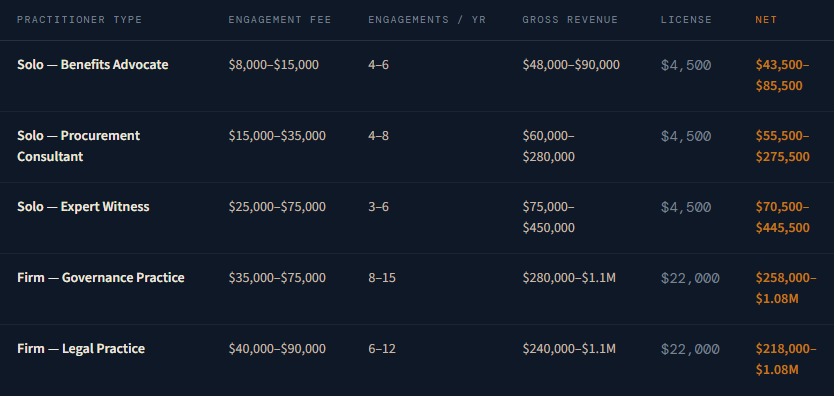
GCR-002 recurring revenue: Every GCR-001 you issue creates a recurring annual GCR-002 renewal engagement at $1,500–$3,500. A practitioner with 10 active certified clients generates $15,000–$35,000/yr in maintenance revenue before any new diagnostic engagements. This compounds as your client base grows.
FOUNDING MEMBERSHIP
The first cohort isn't buying
a product.
They're building an institution.
"Founding practitioners are not early adopters of a product. They are co-builders of an institution."
HSRL Founding Principle
The first cohort of HSRL practitioners is taking a real professional risk — building their practice on a framework that has strong evidentiary foundation but no market track record yet. That risk deserves recognition and active support, not a discount code.
Year one is free. The founding rate is locked regardless of future price increases. Founding practitioners have direct access to HSRL leadership and their input into platform development is structural, not advisory. The founding designation is permanent — it appears on every GCR you issue and on your directory listing, indefinitely.
The founding cohort is deliberately small. This is not a marketing program. It is the practitioner infrastructure HSRL needs to build the market it's trying to serve.
What founding members commit to
→Complete HSRL certification within the first six months
→Run at least two documented diagnostic engagements during the first year
→Participate in monthly education sessions and provide structured feedback on the curriculum
→Contribute at least one case study or methodology observation to the community forum
→Respond to HSRL's structured feedback requests on the platform, diagnostic tools, and document outputs
What HSRL commits to founding members
✓Practitioner SGL — free(as with all practitioners, always)
✓Education — free· Full foundations curriculum, all training modules, continuing education hours for the duration of founding membership
✓Certification — free· HCGD practicum, assessment, and credential issuance at no cost in year one
✓Practice management support· Supervised practicum, year-one mentorship from certified HSRL mentors, structured feedback on your first engagements, direct access to HSRL founding director
✓Growth support· Priority directory placement, input into platform and framework development, early access to new SGL modules and domain expansions
✓Full Solo platform access — diagnostic platform, case match engine, document output
✓Founding rate locked from year two regardless of future price increases
✓Permanent founding cohort designation on your credential and every GCR you issue
CHAPTER LEADER PROGRAM
Extend the framework's reach
into the places that need it most.
An HSRL chapter leader is a certified practitioner who builds and sustains a practitioner community in a specific geography or domain vertical. Chapter leaders receive free ongoing platform access for the duration of their active leadership.
Regional Chapters
Organized Around Geography
City, state, or multi-state region. Members share regulatory context and benefit from proximity. Best for markets where in-person professional networking is primary and where local regulatory environment shapes practice significantly.
HSRL Chicago · HSRL Southwest · HSRL Pacific Northwest
HSRL Mid-Atlantic · HSRL Southeast · HSRL Great Lakes
Chapter leader responsibilities
Quarterly in-person or virtual practitioner gatherings
Local regulatory and legislative monitoring relevant to automated system governance
Regional case submissions — documenting local system failures for the dataset
Outreach to local government agencies, advocates, and oversight bodies
Mentorship of practitioners new to the region
Benefit: Free ongoing platform access for the duration of active chapter leadership. Access continues as long as the chapter is active.
Domain Chapters
Organized Around Practice Vertical
Members work in the same domain regardless of geography. Share domain-specific case knowledge, regulatory context, and domain-specific failure patterns across the country. Best for specialized practice areas where domain expertise is the primary differentiator.
HSRL Benefits & Welfare · HSRL Healthcare · HSRL Child Welfare
HSRL Financial Systems · HSRL Education · HSRL Public Safety
Chapter leader responsibilities
Domain-specific case monitoring — tracking new failures and resilient deployments
Domain practicum cases — developing training scenarios for new practitioners in the vertical
Domain regulatory tracking — legislation, litigation, and oversight decisions affecting automated systems in the domain
Domain-specific curriculum contribution — enriching foundations training with domain examples
Cross-geography practitioner connection within the domain
Benefit: Free ongoing platform access for the duration of active chapter leadership. Domain chapter leaders also receive co-authorship credit on HSRL domain publications.
PRACTITIONER DIRECTORY
Find a certified practitioner
for your domain.
Every HSRL-certified practitioner is listed in the public directory with their domain specialization, credential status, and GCRs issued. If you're an agency looking for a practitioner, start here. If you're a practitioner, this is where your clients find you.
Practitioner Directory Coming Soon!
Apply for
founding membership.
Tell us your background, your domain, and what systems you're already working with or around. We'll confirm fit, walk you through the certification process, and get you into the founding cohort while it's still open.
Founding cohort open now · Year one free · Practitioner SGL free for all certified practitioners · Practitioner platform access Summer 2026 · HCGD certification launching with platform